
GitRoast
GitRoast
GitRoast is a cross-platform desktop application designed to help developers generate faster, more engaging commit messages without changing their existing Git workflow.
Built with Tauri, Rust, React, and Vite, the app focuses on a simple interaction model: detect the active repository, read the staged diff locally, and generate a single AI-powered commit message on demand.
Overview
GitRoast is intentionally designed as a focused utility rather than a full Git client. It integrates seamlessly into a developer’s existing terminal-based workflow, providing a lightweight and responsive experience.
The core flow: detect repository → inspect staged changes → generate commit message → copy and use in terminal
Key Features
Local-First Workflow
- Repository detection and diff inspection happen entirely on-device
- No data is sent externally unless the user explicitly requests generation
AI-Powered Commit Generation
- Generates a single, usable commit message from staged changes
- Designed to balance clarity and humor without disrupting professional workflows
- Uses a hosted AI service only on demand
Trust-Focused UX
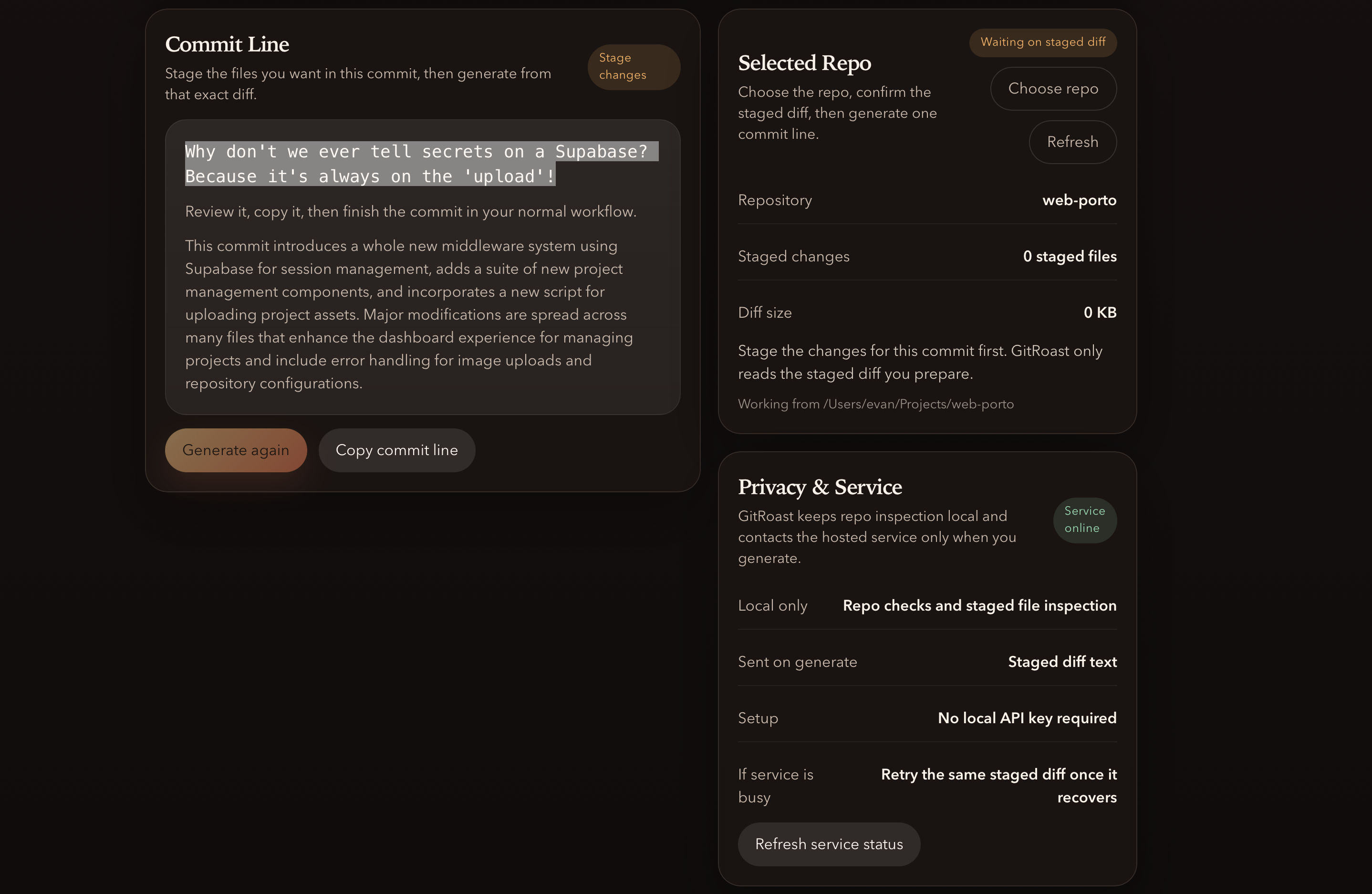
- Clear indication of when data is being processed or sent
- Explicit service availability and error states
- Designed to make behavior predictable and transparent
Robust Error Handling
-
Handles edge cases such as:
- Invalid or missing repositories
- No staged changes
- Large diffs
- Network timeouts and service failures
Cross-Platform Compatibility
- Works across major desktop platforms
- Includes support for Windows environments using WSL-based repositories
Architecture
Backend (Tauri / Rust)
- Executes Git commands
- Validates repositories and reads staged diffs
- Handles platform-specific behavior
Frontend (React)
-
Manages UI state for:
- Repository readiness
- Generation flow
- Service status
-
Focuses on clarity, responsiveness, and minimal friction
Attachments
Project images
Next step
Want the broader picture?
The project pages are intentionally concise and field-based. The broader context lives across the experience timeline and the rest of the portfolio.